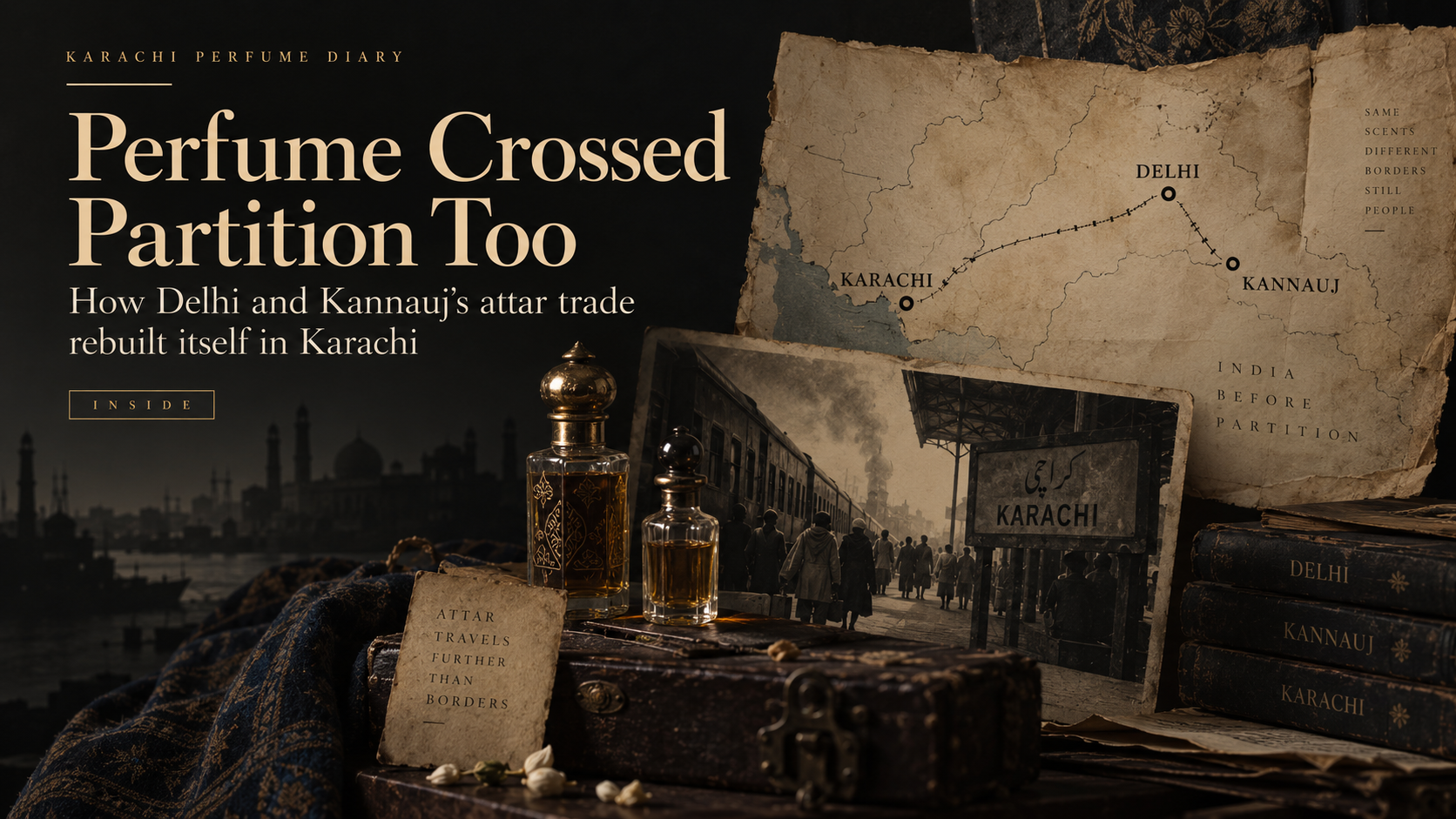
In 1949, a perfume shop called Inshaallah Mashaallah Perfumers opened near Eidgah on M.A. Jinnah Road.
A year later, Raees Ahmed Ansari opened Kannauj Attar House in Karachi.
Read those dates alone and they look like the beginning of two new Pakistani businesses. They were anything but new.
When Dawn visited Inshaallah Mashaallah Perfumers in 2014, its owner Sanaullah said his family had already been making and selling attar before Partition. The business, he explained, had simply been moved to Karachi. Dawn found an entire row of attar sellers near Eidgah whose presence in the area went back to the late 1940s.
Kannauj Attar House carried an even more visible connection to the other side of the new border. According to the family history reported by The Express Tribune, Ansari's grandfather had traded attar before Pakistan existed and would send his son to Karachi to sell it. After Partition, that son, Raees Ahmed Ansari, settled in Karachi and opened the shop in 1950.
Karachi's attar trade, in other words, did not begin from zero in 1947.
Some of its people already knew the customers. They knew the product. They knew where to buy it. And in at least one remarkable case, the old supply relationship continued across the border.
A Karachi shop that kept looking back to Kannauj
The name Kannauj Attar House is unusually literal.
Kannauj, in Uttar Pradesh, has been associated with traditional Indian attar production for centuries. The city's perfumers are known for distillation methods built around copper vessels, botanicals and long-established family knowledge.
The Ansari family had been trading that product before Partition. More strikingly, the connection did not disappear when India and Pakistan became separate countries.
In 2019, The Express Tribune reported that most of the products sold by Kannauj Attar House were still being brought in from Kannauj, including oud, musk and different varieties of attar. The same article described the Karachi business as one of the city's oldest attar shops.
That detail changes the way the story looks.
The family migrated. The shop moved. The country changed.
Kannauj remained part of the business.
It suggests a perfume geography older than the political map around it. Karachi had been one of the family's markets before 1947, and decades later an attar shop in Karachi was still sourcing from the Indian city whose name it carried.
Ansari also told the Tribune that smaller attar shops in Jama Cloth Market would buy products from Kannauj Attar House during the early years of the business. If that family account is accurate, the shop was doing more than serving individual customers. It was feeding part of the developing local trade.
The Delhi perfume businesses that became Karachi names
The same pattern appears elsewhere.
Saeed Ghani today is a familiar Pakistani name across fragrances, herbal products and personal care. Its own company history places the beginning far from present-day Karachi.
The company says its story started in 1888 with a small retail shop in Delhi. Today the business is headquartered in Karachi and continues to sell fragrances alongside its much wider beauty range.
The accessible company history does not give a precise date for the family's transition from Delhi to Karachi, so it would be wrong to invent one. What it does establish is a Delhi beginning and a later Karachi base.
Another old name provides a clearer migration record.
Abdul Ghani Muhammad Ismail says its business was established in 1904 in Chandni Chowk, Fatehpur, Delhi, where Abdul Ghani and his son Haji Muhammad Ismail worked with natural herbs, fragrances and perfumes. According to the company's own history, Haji Muhammad Ismail migrated to Karachi in 1947 and re-established the business there under the same name.
A Pakistani trademark record gives some independent evidence for the continuing Karachi business. A 2015 trade marks journal lists Abdul Ghani Muhammad Ismail in Karachi and refers on the label to “Perfumers” and the year 1904.
These are different families and different businesses. Their histories should not be flattened into one neat lineage.
Together, though, they begin to reveal a pattern.
Delhi's perfume trade did not survive in Karachi as an abstract cultural memory. Parts of it survived as surnames, shop names, businesses and commercial knowledge.
Then there is the community record
The most revealing evidence may come from outside the perfume companies themselves.
Jamiat-e-Hakiman (Delhi) Pakistan describes a Delhi community made up of several interrelated families, including a group identified as Attar. According to its own historical account, earlier generations worked in Unani medicine and traded other merchandise, including perfumes.
Over time, the occupational network and intermarried families became known as Qom Attaran-o-Hakiman.
The word Attaran is sitting there in the community's old name.
Then came Partition.
The Jamiat says that around 80 percent of the community's members settled in Karachi after 1947. Others moved to cities including Hyderabad, Lahore, Rawalpindi and Peshawar.
That figure gives the perfume-shop histories a much larger context.
The movement from Delhi to Karachi was not necessarily a handful of unrelated merchants independently making the same choice. A substantial Delhi community with historical links to medicine, attar and perfume trading was itself re-forming in Karachi.
Trade knowledge could therefore travel through family relationships as much as through formal companies.
Someone knew a distiller.
Someone knew which oil to buy.
Someone knew which customer wanted musk rather than rose.
Someone knew which merchant back in India could still supply the product.
A border can be drawn quickly. Commercial memory is harder to redraw.
Partition changed the address, not every relationship
Partition histories tend to preserve the things that are easiest to see: houses left behind, businesses restarted, neighbourhoods populated, foods carried from one city to another.
Perfume leaves a weaker paper trail.
A formula may never have been written down. A supplier relationship might exist only between two families. Knowledge of quality, dilution, storage or customer taste can live in the person behind a counter rather than inside a company archive.
That makes these surviving records unusually valuable.
Inshaallah Mashaallah Perfumers gives Karachi a documented example of a pre-Partition attar family opening here in 1949.
Kannauj Attar House shows a pre-1947 trading relationship with Karachi that became a permanent shop after migration, while its connection with Kannauj was still visible generations later.
Abdul Ghani Muhammad Ismail records a business beginning in Chandni Chowk in 1904 and being re-established in Karachi after its family migrated.
Saeed Ghani carries another Delhi origin story, beginning in 1888, into a business now identified with Karachi.
And Jamiat-e-Hakiman supplies the wider social evidence: an old Delhi community whose history included Attar families and perfume trading, with most of its members settling in Karachi after Partition.
Individually, these are business histories.
Put beside one another, they become part of Karachi history.
Karachi inherited more than shops
There is another important detail in the Kannauj story.
Before Partition, the Ansari family was already sending attar to Karachi.
That means the city was already connected to northern India's fragrance trade before it became part of Pakistan. Migration did not create that commercial relationship. It changed its form.
After 1947, the seller who once came to Karachi as part of a trading route became a Karachi resident. The distant market became home. The supplier city became foreign.
Yet perfume continued moving.
This helps explain why some of Karachi's oldest fragrance businesses can feel simultaneously local and much older than Pakistan itself. Their history belongs to Karachi, but part of their commercial ancestry lies in Delhi, Kannauj and the trading culture of the undivided subcontinent.
The Pakistani perfume market that later developed around attars, imported oils, impressions, modern sprays and local fragrance brands was therefore built on more than new entrepreneurship. In some corners of the city, it inherited experienced perfume families who had already spent decades in the trade.
The part of the story still missing
The surviving material also exposes how much remains undocumented.
Exactly how many Delhi attar families restarted businesses in Karachi after 1947?
Where did they first cluster?
Which families continued buying from Indian suppliers, and how did wars, import restrictions and changing trade rules affect those relationships?
How much of Karachi's later perfume trade grew from these families, and how much developed independently?
The available company histories and newspaper profiles cannot answer all of that. Some are family accounts and should be treated as such. A proper oral history would require speaking to the older perfume families themselves and comparing their memories with business records, advertisements and trade documents.
But the outline is already visible.
Partition moved millions of people. Among the possessions, professions and habits that arrived in Karachi was an old perfume culture.
It came from Delhi families who had traded fragrances for generations. It came through Kannauj supply relationships that were older than Pakistan. It came through a community once known, in part, by the word Attaran.
And in Karachi, much of it went back to work.