In 2011, Dawn went to Botal Gali to photograph bottles.
The story was exactly what the street’s name promised: second-hand glass, plastic containers, carved bottles and small palm-sized vessels used by Karachi’s perfume and ittar trade. Fifteen years later, a Dawn columnist returned to the same part of Saddar and described the gali as “more perfume than bottles.”
Source: Dawn, “Exploring Botal Gali” (2011)
Source: Dawn, “City in a pickle” (2026)
Those two snapshots capture a bigger change in Karachi.
The perfume business did not simply move from an old market to the internet. The counter, the wholesaler, the website, the courier and the WhatsApp chat have gradually become parts of the same system.
And Botal Gali never really left the picture.
Before the perfume, there was the bottle
The history of Botal Gali is slightly untidy, which is probably appropriate for a Karachi street that has been repurposed repeatedly.
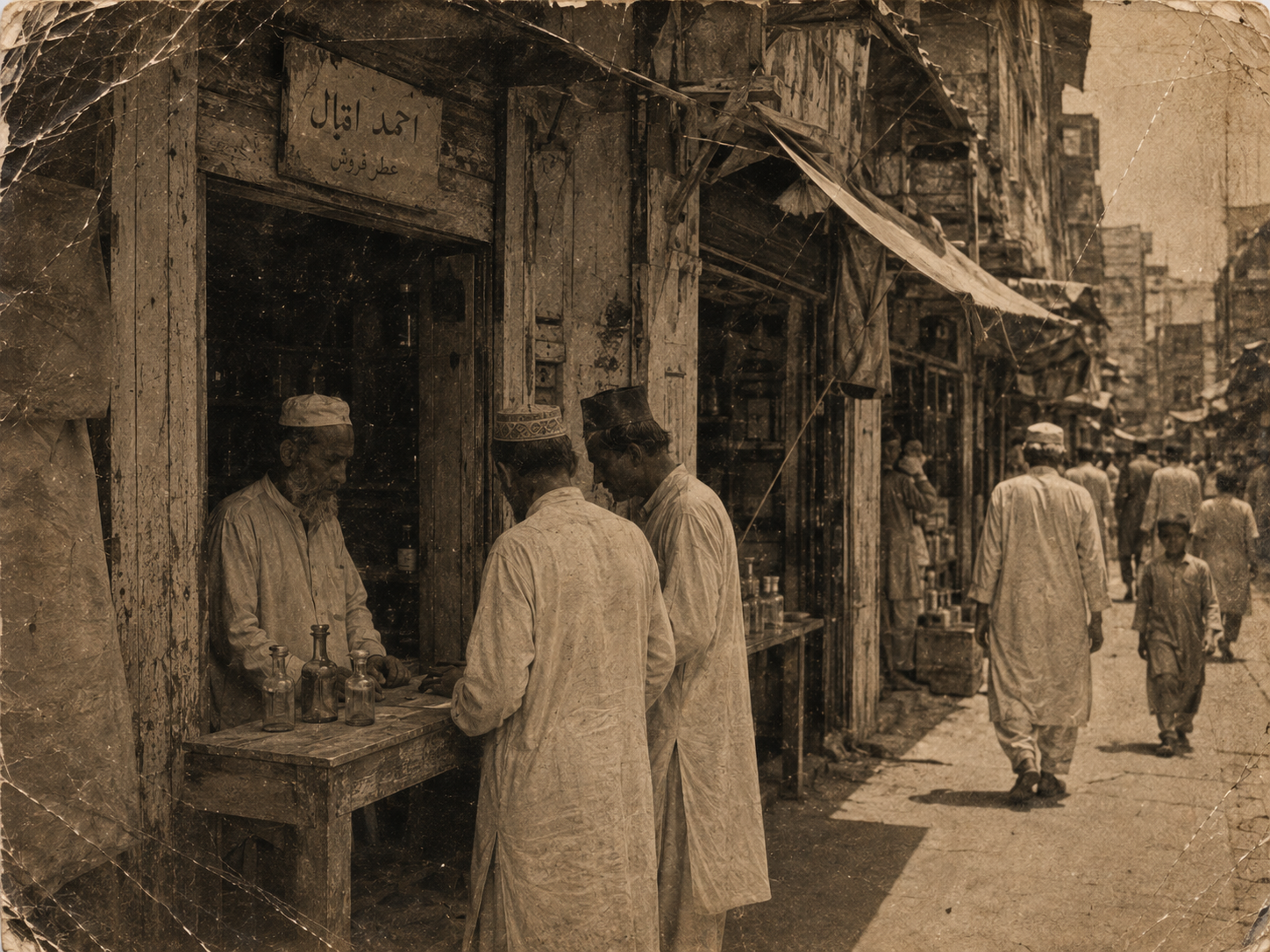
A 2013 Express Tribune feature recorded shopkeepers recalling that the area was known as Parsi Gali in the early years after Partition. As residences gave way to commerce, shops appeared selling bottles for perfumes, medicines, drinks and other uses. A later account of Karachi’s named streets linked the Botal Gali name specifically to shops selling perfume bottles. The exact origin story varies between accounts, but the bottle trade itself is well documented.
Source: The Express Tribune, “Botal Gali: A street that should live again” (2013)
By 2011, Dawn was already noting the connection between those bottles and the local perfume industry. In 2015, its city guide described Botal Gali as having both second-hand bottles and an increasingly diverse perfume collection.
Source: Dawn, “12 stops: A Do-It-Yourself tour of Karachi” (2015)
Then perfume began taking over.
A 2022 photo story documented perfume vendors gradually replacing some of the older bottle trade, even noting that people had started calling the area Perfume Gali. In 2023, The Express Tribune described Botal Gali as the country's biggest perfume and attar market, with local and imported fragrances sold there at retail and wholesale.
Source: The Express Tribune, “A waft of attar in the holy month” (2023)
The street had changed its main product without losing the reason it mattered.
The digital perfume business existed before the website
One of the most interesting records of how Karachi perfume actually moves comes from somewhere else in the city.
For Hybrid, the journal of the Indus Valley School of Art and Architecture, researcher Ali Mehdi Zaidi spent time at Perfume Chowk in Gulistan-e-Johar. His fieldwork documented a roadside fragrance business whose owners travelled to Botal Gali every two or three days to replenish oils from suppliers.
That alone shows how far Botal Gali's reach extends beyond the physical lane.
The rest is even more revealing. Perfume Chowk maintained records of every sale and had accumulated a non-digital customer database over roughly 25 years. Advertising messages could reach nearly 22,000 phone numbers. The business also offered home delivery, using its own riders locally and courier companies for customers as far away as Quetta and Dera Ismail Khan.
Source: Ali Mehdi Zaidi, “Perfume Chowk and the Smelling Class,” Hybrid, Vol. 7
This was customer relationship management before anyone needed to call it CRM.
There was a supplier network, a customer database, direct marketing and delivery. The notebook and SMS eventually became the website, order-management system and WhatsApp message, but the basic commercial idea was already there.
Karachi's perfume business did not have to learn how to sell remotely from scratch.
It had to learn how to do it at scale.
Then the catalogue stopped fitting behind the counter
Consider Shop Forever.
The Karachi retailer says its website launched in January 2016 and that it has since shipped more than 150,000 packages across Pakistan. Its current operation combines a website, cash on delivery, nationwide shipping, WhatsApp support, a wholesale location on M.A. Jinnah Road and a physical showroom in Bahadurabad.
Source: Shop Forever, About
Then there is the number that gives this story its title.
Shop Forever's current Urdu copy advertises a choice of 5,000+ fragrances. An English paragraph higher on the same page actually claims more than 10,000 fragrances. KPD has not independently counted the live catalogue, so neither figure should be treated as an audited inventory total. The useful point is the scale the retailer itself is trying to communicate.
Five thousand is already a strange number when placed beside the old image of a customer walking into a lane and examining bottles one shelf at a time.
A physical shop is limited by wall space. A website can keep adding another brand, another size, another concentration, another decant.
The problem for the buyer changes with it. Finding perfume used to mean finding the right shop. Now it can mean finding your way through too many options.
Karachi also produced brands that began with the screen
Traditional retailers putting their stock online are only half the story.
The other half is the rise of fragrance businesses designed around direct selling from the beginning.
Scents N Stories is the clearest Karachi example. The company lists Karachi as its headquarters and describes itself on LinkedIn as a direct-to-consumer fragrance e-store founded in 2018. Nukta reported in 2025 that what began as a small essential-oils business developed into a dedicated fragrance e-store and eventually 32 physical outlets.
Source: Scents N Stories on LinkedIn
Source: Nukta, Scents N Stories profile (2025)
The sequence is important.
A traditional perfume business usually began with a counter and later added a website.
Scents N Stories went the other way.
Its own company history says its Perfume Studio, launched in 2021, represented a move from e-commerce into retail. Its current outlet directory includes locations across Karachi in malls, commercial districts and neighbourhoods including Atrium, LuckyOne, Ocean Mall, Tariq Road, Bahadurabad, Model Colony and Millennium Mall.
Source: Scents N Stories, company milestones
Source: Scents N Stories, outlet directory
Digital fragrance retail eventually built physical shops because perfume still has a problem that technology has not solved.
You cannot smell a product page.
WhatsApp became another perfume counter
The most revealing examples may be the businesses where old and new are no longer easy to separate.
Premium Perfume Store gives its physical address as Bottle Gali in Saddar. On the same page, it advertises more than 325 perfume oils and attars and calls WhatsApp its fastest response channel for orders, recommendations and wholesale enquiries. Customers can browse online and send the order through WhatsApp. WhatsApp support continues seven days a week even though the physical shop closes on Sunday.
Source: Premium Perfume Store
Al-Imsal offers another version of the same arrangement. It lists shops in Botal Gali, operates an e-commerce catalogue, dispatches orders from Karachi and tells customers they can use WhatsApp to change delivery details before an order ships.
Source: Al-Imsal, contact and delivery information
The internet did not replace Botal Gali in these cases.
Botal Gali acquired an internet connection.
A customer no longer has to choose between the old perfume market and digital convenience. The same seller can exist as a shop address, a search result, a product page and a WhatsApp conversation.
What the website still cannot reproduce
Zaidi's fieldwork at Perfume Chowk also records something that explains why physical perfume retail keeps surviving.
Customers often arrive without being able to name exactly what they want. Sellers move through stronger, lighter, sweeter and sharper options until a customer reacts to one. Perfume is unusually resistant to description because the important information has to be smelled rather than read.
Online fragrance businesses have responded with quizzes, sample sets, downloadable catalogues, customer-service chats and increasingly detailed scent descriptions. Scents N Stories, for example, offers a downloadable catalogue containing prices, comparable scents and notes, alongside next-day delivery in parts of Karachi and a customer-service number that accepts voice notes.
Source: Scents N Stories, product catalogue
These tools reduce the distance between buyer and seller.
They do not eliminate the nose.
That helps explain one of the oddest developments in Pakistan's fragrance business: successful online perfume brands keep opening physical stores while physical perfume shops keep building websites.
Both sides are travelling toward the middle.
Botal Gali may now be bigger than the lane itself
There is an easy version of this story in which an old Karachi market is gradually defeated by e-commerce.
The evidence points somewhere more interesting.
Botal Gali became increasingly perfume-focused as the bottle trade changed. Sellers elsewhere in Karachi continued travelling there for stock. Retailers created customer databases and delivery networks. Websites allowed thousands of products to sit inside searchable catalogues. D2C brands used online demand to build national businesses, then opened stores so customers could smell in person. Meanwhile, businesses physically located inside Botal Gali began taking orders through their own websites and WhatsApp accounts.
In May 2026, when Dawn returned to Botal Gali, the writer could easily have ordered the jars she needed online. She went to Saddar instead and ended up talking to an older shopkeeper whose son and grandson represented successive generations of the business.
That detail may explain the whole transition better than any e-commerce statistic.
Karachi can now put thousands of fragrances on one screen. It can deliver a bottle across the country and answer a perfume question through WhatsApp.
But when the screen reaches the limit of what it can tell you, there is still a counter, a bottle and somebody standing behind it who has smelled this before.